


Your Visibility Problem Might Actually Be a Marketing Infrastructure Problem

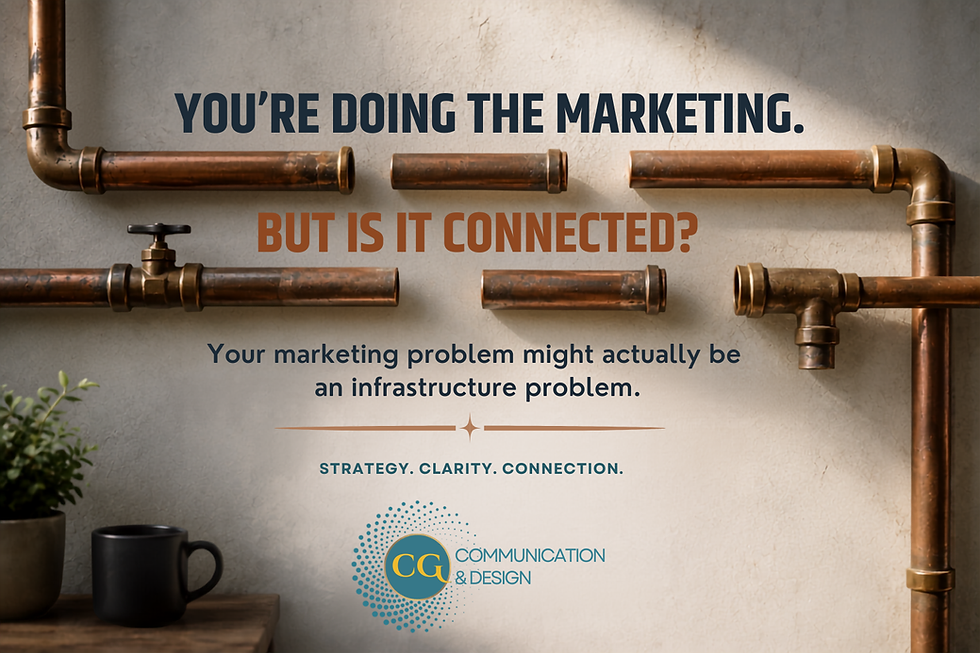
You posted three times this week. You sent the newsletter. You updated the website. You tried an ad. You downloaded another lead magnet about lead magnets. And somehow, your pipeline is still making cricket noises.
Maybe you don't have a marketing problem. Maybe you have a marketing infrastructure problem. For many small businesses, nonprofits and mission-driven organizations, the challenge isn't a lack of marketing activity. It's that their marketing strategy, messaging, website, content, CRM, lead generation and follow-up systems aren't working together.
And adding more marketing to a disconnected system usually just creates more things to manage.
Marketing Strategy Isn't Supposed to Be a Collection of Random Acts
For a lot of small businesses and nonprofits, marketing has grown one piece at a time.
Someone said you needed social media, so you started posting. Someone said email marketing was where the money was, so you built a list. Then came SEO. Then lead magnets. Then ads. Then a CRM. Then automation. Then AI.
Then somebody on the internet informed you that if you're not optimizing for SEO, AEO, GEO and approximately 14 other acronyms, civilization as we know it may collapse. So now you have a lot of marketing things. But having marketing things isn't the same as having a marketing system.
An effective marketing system connects those things so each one has a purpose — and each interaction leads naturally toward the next. Someone discovers you. They understand what you do. They see why it matters to them. They're given a logical next step.
If they're interested but not ready, the relationship continues. If they become a lead, someone follows up. If they're qualified, they move toward a conversation. If they become a client, customer, donor or supporter, you know how they found you — so you can learn from what worked.
That's marketing infrastructure. And when it isn't there, even good marketing can feel strangely ineffective.
What Is Marketing Infrastructure?
Marketing infrastructure is the connected set of strategies, messages, technologies, processes and workflows that move people from discovering an organization to taking meaningful action.
Depending on the organization, that infrastructure might include:
Brand positioning and core messaging
Website strategy and conversion paths
Content marketing and social media
Search engine optimization (SEO)
Answer engine optimization (AEO)
Generative engine optimization (GEO)
Lead generation
Landing pages and lead capture
Customer relationship management (CRM)
Email marketing and lead nurturing
Marketing automation
Sales follow-up workflows
Analytics, attribution and conversion tracking
You don't necessarily need every item on that list. You do need the pieces you use to work together. That's the difference between having a collection of marketing tactics and having a growth system.
The Invisible Leaks in Your Growth System
Imagine someone sees one of your LinkedIn posts and thinks: Oh. These people understand my problem. Excellent. They click your profile. Then your website. And now things start getting fuzzy.
Maybe the website doesn't quite explain the same thing the post did. Maybe there are six services competing for their attention. Maybe the only next step is a generic Contact Us button. Maybe they fill out a form and receive an automated message informing them that their submission has been received. Thrilling. Or maybe they aren't ready to contact you yet, so they simply leave. That person wasn't necessarily a bad lead. Your marketing didn't necessarily fail. The path broke.
These breaks happen everywhere: A great piece of content with nowhere meaningful to send people. A website generating traffic without a clear conversion path. A lead magnet with no email nurture sequence behind it. A promising inquiry that isn't followed up consistently. A CRM full of contacts nobody is actually nurturing. Social media activity that never connects to lead generation. An advertising campaign producing clicks without tracking which visitors become qualified leads or clients. A fantastic discovery call followed by... well, somebody was going to send that follow-up email. Each leak can look insignificant. Together, they can quietly drain an enormous amount of opportunity.
More Traffic Won't Fix a Leaky Customer Journey
This is where organizations often get trapped. When growth slows, the instinct is: We need more leads. So we increase the ad budget. Post more frequently. Start another campaign. Try another platform. Hire someone to do outreach. And sometimes more visibility really is the answer.
But if the customer journey and lead-conversion infrastructure underneath that visibility aren't working, you're essentially pouring more resources into a system that isn't equipped to convert the attention it already receives.
Before asking: How do we get more people to find us? Ask: What happens after they do? Can someone understand your value quickly? Is your messaging consistent across your website, social media, advertising and sales conversations? Is there an obvious next step?
Can you capture interested people who aren't ready to buy today? Do you have an effective lead-nurture strategy? Does routine follow-up happen automatically where appropriate? Does your team know when human follow-up is needed? Are your CRM and marketing automation systems actually supporting your sales process? Can you tell which marketing activities generate meaningful opportunities rather than likes, impressions and clicks?
If the answers are fuzzy, your next growth investment may not need to be more marketing.
It may need to be better connective tissue.
Where AI and Marketing Automation Fit
Naturally, AI has entered the chat. And it has created another tempting idea: Maybe we can automate all of this. Sort of.
AI-powered marketing automation can make a strong communications and growth system dramatically more effective. AI and automation can help organizations:
Research and qualify prospects
Personalize outreach
Organize customer and lead information
Trigger timely follow-up
Nurture leads over time
Repurpose content across channels
Analyze marketing and sales data
Identify patterns and opportunities
Reduce repetitive administrative work
Help small teams operate with greater capacity
But automation has one particularly inconvenient characteristic: It automates whatever you give it. A smart strategy can become faster and more scalable. A confusing strategy can become confusing at tremendous speed.
AI cannot compensate for unclear positioning, fragmented messaging or a customer journey that doesn't make sense. The technology should support the system. It shouldn't be the system.
SEO Isn't Enough Anymore, Either
For years, organizations focused primarily on getting found through traditional search engines. That's still important. But people increasingly discover businesses and organizations by asking complete questions — in search engines, voice assistants and generative AI tools.
That means your content needs to do more than contain keywords. It needs to demonstrate clear expertise and answer real questions well. Traditional search engine optimization (SEO) helps search engines understand and surface your content. Answer engine optimization (AEO) structures content so direct-answer systems can identify useful responses to specific questions. Generative engine optimization (GEO) aims to make your organization and expertise understandable and discoverable within AI-generated answers and recommendations.
The terminology will continue evolving. The underlying principle probably won't: Be clear. Be useful. Demonstrate expertise. Answer the questions your audience is actually asking. That's good communication strategy whether the reader finding you is a human, Google or an AI assistant trying to help that human.
What Does Good Marketing Infrastructure Look Like?
It doesn't necessarily mean an enormous tech stack or a terrifying dashboard with 47 blinking widgets. For many organizations, the best system is surprisingly simple.
Your brand messaging clearly communicates who you help, what you help them accomplish and why your approach matters. Your content strategy creates awareness, demonstrates expertise and builds trust. Your website carries that same story forward and provides clear conversion paths. Interested people have a natural way to raise their hands.
Your CRM remembers what humans inevitably forget. Your email marketing and lead-nurture system continue relationships over time. Your marketing automation handles predictable, repetitive processes. Your people step in where judgment, empathy, creativity and actual conversation matter. And your analytics and conversion tracking tell you what's working so you can keep improving the system.
Suddenly, your website isn't doing one thing while social media does another and somebody's spreadsheet is hiding in a dark corner wondering why nobody has opened it since February. They're connected. That's when communications starts becoming growth infrastructure.
You Probably Don't Need to Do More
This may be the best news of all. If your marketing feels exhausting, the solution may not be to produce more. You may not need another social platform. You may not need to publish seven days a week. You may not need another piece of software. You may not even need more leads yet. You may simply need to make the pieces you already have work together.
Because sustainable growth doesn't come from doing every possible marketing activity.
It comes from creating a clear path between: Being seen → being understood → being trusted → becoming a lead → having a conversation → becoming a client, customer or supporter.
Then you strengthen that path. Then you automate the parts that shouldn't require a human.
Then you put humans back into the places where humans are actually wonderful. And then you turn up the volume. Because once the infrastructure can reliably turn attention into opportunity, investing in more visibility makes a whole lot more sense.
Build the System Before You Turn Up the Volume
At CG Communication & Design, we help mission-driven businesses, nonprofits and entrepreneurs connect the pieces between strategy, messaging, visibility, technology and growth. Because you shouldn't need five disconnected vendors, seven platforms and a heroic amount of manual follow-up just to figure out whether your marketing is working.
We look at the whole journey: How people find you. What they understand about you. What happens next. Where opportunities disappear. What should be automated. And where a real human should step in. Then we help build a communications and growth system designed around the organization you actually have — and the one you're trying to become.
Key Takeaways
If you're short on time, here's the big picture:
More marketing doesn't automatically create more growth. If your systems aren't connected, increasing traffic or content can simply send more people into a leaky customer journey.
Marketing infrastructure connects visibility to opportunity. Your messaging, website, content, lead capture, CRM, email nurture, sales follow-up and measurement should function as parts of one system.
Many apparent lead-generation problems are actually conversion or follow-up problems. Before spending more to attract people, examine what happens after they find you.
AI and marketing automation amplify systems; they don't replace strategy. Automating a confusing customer journey just makes the confusion happen faster.
The goal isn't to do more marketing. It's to build a clearer path from visibility → trust → lead → conversation → client or supporter.
Frequently Asked Questions
What is marketing infrastructure?
Marketing infrastructure is the connected system of strategy, messaging, technology and processes that supports an organization's marketing and growth. It can include a website, CRM, email marketing, content strategy, lead-generation tools, marketing automation, sales workflows, analytics and conversion tracking. Strong marketing infrastructure ensures these pieces work together rather than operating independently.
How do I know if my business has a marketing problem or a systems problem?
If you're consistently generating visibility or inquiries but aren't seeing enough qualified leads, conversations or sales, examine what happens between initial awareness and conversion. Inconsistent messaging, unclear calls to action, weak follow-up, disconnected technology, poor lead nurturing and inadequate tracking can indicate a marketing infrastructure problem rather than simply a lack of traffic.
What is the difference between marketing strategy and marketing infrastructure?
Marketing strategy determines who you're trying to reach, what you want to communicate and how you'll create growth. Marketing infrastructure is the system that executes and supports that strategy. Strategy provides the direction; infrastructure helps turn that direction into repeatable action.
Can AI automate my marketing?
AI can automate and accelerate many marketing activities, including research, personalization, content repurposing, lead nurturing, analysis and follow-up. However, AI works best when it supports a clear strategy and well-designed customer journey. Automating a fragmented marketing process generally makes the process faster, not better.
What is the difference between SEO, AEO and GEO?
SEO (search engine optimization) helps content become discoverable through traditional search engines. AEO (answer engine optimization) focuses on making content useful and understandable to systems that provide direct answers to questions. GEO (generative engine optimization) focuses on helping brands, organizations and expertise become understandable and potentially discoverable through generative AI platforms. All three benefit from clear, authoritative, well-structured content that genuinely answers audience questions.
Does a small business need a CRM and marketing automation?
Not every small business needs a complicated technology stack, but most growing organizations benefit from having a reliable way to track leads, maintain relationships and ensure follow-up happens. A CRM and thoughtfully designed automation can reduce missed opportunities while allowing a small team to operate more efficiently.
Should I fix my marketing system before spending more on ads?
Often, yes. Before significantly increasing advertising or lead-generation spending, make sure your website, messaging, lead capture, follow-up, nurture and conversion tracking are functioning effectively. Otherwise, additional traffic may simply amplify existing gaps in the customer journey.
Doing all the marketing things but still not seeing consistent opportunities? Let's find the gaps — and connect the pieces. Book a free strategy call today!




Comments